Friday, March 14, 2008
Povray export in Mercury CSD
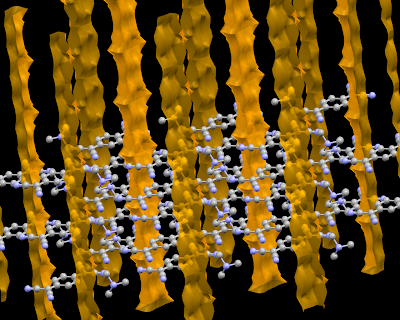
One of the nice, new feature of Mercury CSD 2.0 is export to Povray. You can create high quality picture like one below.
I used refcode MATCQI04 and Display->Voids and Calculate->Packing&Slicing option to produce the picture. If you are interesting in these as well other features of Mercury please check the article in J. Appl. Cryst. [DOI: 10.1107/S0021889807067908].

Monday, March 10, 2008
Unix tips
Today I would like to share two link related to UNIX.
The first one is IBM tips how learn 10 good UNIX usage habits.
The second one is The ultimate collection of UNIX cheat sheets by Scott Klarr.
Sunday, February 24, 2008
Introductions not only to Quantum Chemistry
Supercomputer Institute at University of Minnesota presents set of PDF files being nice introduction to resources available there. Most of them are related to Quantum Chemistry, but there is also CSD System and Material Studio. If you are interested please check the link.
Thursday, February 21, 2008
4 blogs - 4 maybe not so different subject
I would like to present 4 interesting blogs from 4 different area:
- Bash Cures Cancer, how it is easy to guests, is a nice blog mostly about Bash tips&trick. However, you can also find infos about other FOSS.
- I'm not sure if you can call Molecules of the Month @ 3DChem a blog. I think it's older than idea of blog (it has been started in 1996). The subtitle (molecules of the month) indicates one molecule per month, but molecules have been added in random manner - no molecule between October 2007 and January 2008 and 4 in January. Anyway, the choose of molecules are quite good and the additional information can be really useful.
- Bad Astronomy Blog is a good blog about astronomy. I visited it first because of this entry, especially because of this picture.
 Just be aware that from time to time there are some politics/religion related entries.
 - Finally, Online Video Streaming Archive is looking promising place where Nature (one of the best/the best scientific journal on Earth ;) presents streaming videos that feature interviews with scientists behind the most important present research.
Wednesday, January 30, 2008
Dalton problems 2: Too long input record (ERI)
Problem
My CC calculations stopped with the forrtl: severe (22): input record too long, unit 9, file /tmp/niewod/RhbCCS/betaccs_rhb631+gd/CCSD_IAJB error message.
I changed four things and the job finished properly.
- First I changed a machine, but both were Itanium.
- Next I lowered the print level from 3 to 2.
- In the original jobfile I requested a direct calculation in a CC part, in the new one I put .DIRECT keyword in a main part (for all calculations).
- Finally I requested more memory (1900mb).
forrtl: severe (32): invalid logical unit number, unit -10001, file unknown
I reran jobs with new commands at the first machine, and it worked. Next I upgraded print level to 3 and job finished with success. So the issue could be cause by small amount of requested memory or direct/non-direct calculation in a HF,MP2 or CC calculation.Files
Monday, January 21, 2008
Dalton problems 1: Direct and NonDirect HF
Short introduction
Once, I tried to create a website with notes on my Dalton's problems. I have had not time to upgraded it because Quantum Chemistry (and Dalton) has become much less important for me. Recently, I've decided that the best way to save my notes would be to add them as entries in my English blog. So they are.
ProblemI found difference between direct and non-direct Hartree-Fock results. The direct calculation didn't converge when non-direct did (look into the files below).
AnswerThe reason of my problems was a very sharp convergence criteria. The screening in the direct SCF gives round-off errors, which makes it impossible to converge to 1.0D-10. (The default screening is 1.0D-14, which is usually safe, unless users ask for very sharp convergence,as I did!) Disable screening in the direct SCF, resolve my problem. I had to add:
**INTEGRALS
*TWOINT
.IFTHRS
20
When convergence was set to 1.0D-09 the difference between direct and non-direct results disappear and both calculations converged in 28 iterations, with (nearly) the same energy:
- direct_rhb631+gd.out: -551.031670938128
- nodirect_rhb631+gd.out: -551.031670938119
I would like thanks Kenneth Ruud and Hans Jorgen Aa. Jensen for help.
FilesFriday, December 28, 2007
PC GAMESS benchmarks
Alex Granovsky presented the results of the PC GAMESS (version of Gamess US designed to work better on x86 architecture) benchmarks on new AMD Opteron and Intel Core2 processors. You can find them here.
The most important observations are:
- Intel CPUs are much faster,
- but AMDs scale better with number of cores.
BTW. You can find other interesting benchmark in the Performance section of the PC GAMESS website.
Friday, December 21, 2007
Tips for starting MacOSX apps
- If you want to start a MacOSX applications from a terminal (or a shell script) you have to use the open command, i.e.:
open /Application/Firefox.app(based on xahlee.org) - If you need to write a wrapper starting a binary file (which is inside of a MacOSX app) with some options you can use following construction:
HERE=`dirname $0`; $HERE/name.x -optionsThe same construction is useful if you need to set some environment variables. - Sometimes is it necessary to have a location of an app, but apps can be place in a very strange places. MacOSX binaries are located third level deep inside of an app, so the following command save location of an app in the TOPDIR variable:
TOPDIR=`cd $HERE/../../../; pwd`
Sunday, December 09, 2007
3D in Linux
There is a very interesting overview of present state (Nov 2007) of 3D graphic card drivers on Mitch Meyran's blog.
Wednesday, December 05, 2007
Friday, November 02, 2007
OpenGL and Windows
I'm starting to me more interesting in 3D graphic. Looking for some information about OpenGL on Windows I found Lucian Wischik old webpage. Maybe information collected on it isn't the latest news, but at least one thing is quite interesting. There is a register key which keep information about which library provided OpenGL functionality on your computer.
HKEY_LOCAL_MACHINE\Software\Microsoft\Windows\CurrentVersion\OpenGLDrivers.
The another interesting finding is OpenGL Extension Viewer provided by RealTech-Vr. It works on Windows, MacOSX and under Wine.
Monday, September 10, 2007
Getting the Molcas CASPT2 exciation energy
This is the short bash/awk script printing an energy of excitation to a first excited stated obtain by CASPT2 method in Molcas6:
for i in *.log
do echo $i
grep "Total energy:" $i| gawk ' BEGIN {l=1} {if (l==1) {a=$3} else if (l==2) \
{b=$3; print 27.2097*(b-a)} l++} '
done
Friday, August 17, 2007
LaTeX font catalog
If you need nice, non-standard fonts for LaTeX visit Palle Jørgensen LaTeX Font Catalogue.
Saturday, July 07, 2007
I Gited my PhD
From the beginning of writing my PhD thesis I've been using RCS to store revision of my tex files. I even add settings to my GVIM that Ctrl+S make a new revision. Recently, when I started to finishing Phd ;), I found lack information about files other than main tex files (tabels, figures etc). I also wanted to be sure that change prepered on one machines can be easily reach from other ones. I decided to use something more complex than RCS and chose git. It is very easy to send commits to my academic server (
git push ssh://user@server/~/PhD) and getting the latest version from it (git pull ssh://user@server/~/PhD). However, I found that it isn't so easy to edit files on my server. Directory doesn't change after pushing it from remote repository.
My first work around was on the server first committing changes - it means reverting files to state before pushing, and latter reverting to previous version -it means last version committed from remote machine.
Does it sound complicated?
Yes!
So I was trying find the other way. Today I found it.
On remote machine I do:
git add filename(if needed)
git commit -a
git push ssh://user@server/~/PhD
Later on server:
git reset --hard HEAD
And now I has the same files at server and any remote machines. Nice. And I need only ssh to do it.
Thursday, April 19, 2007
Nekochan.Net
If you like IRIX and other old UNIX systems, Nekochan.Net is a place for you. There are a lot of software for IRIX, very interesting forum (not only about IRIX) and nice screenshots, like this one:


Wednesday, April 04, 2007
Comparing two list of files
I had to compare list of files, which was stored in two files. I wrote a small shell script.
for i in `cat ~buildman/WhiteList`
do
        grep $i ~buildman/BlackList
done
But beware it is taking each line of WhiteList as a substring. So if you have aaa in WhiteList that aaaaa from BlackList will be printed out.
Tuesday, March 20, 2007
Find
Unix find command is powerful tool. Recently, I learn how to use it to fix wrong permission of a whole directory tree (hundres of files). If you will be in similar situation try to use:
find -nouser - looking for files (directories) not belongs to user.
find -type f -not -perm 644 - looking for files with permision other that 644
find -type d -not -perm 755 - looking for directories with permision other that 755
Thursday, March 01, 2007
10 nice shell command
Here you can find 10 nice, but not very other using shell command. Personally, I was using bc and lsof.
Tuesday, February 20, 2007
Solaris vs. Linux for Application Developers
At Sun Developer Network there is quite the
article examines similarities and differences in the development environments between Linux and Solaris operating systems.
Thursday, February 01, 2007
Another interesting blog about HPC
John West, the Director of the DoD Major Shared Resource Center at
ERDC in Vicksburg, MS has created a blog where he discusses new developments in HPC. Check it out - very interesting info.
Subscribe to:
Posts (Atom)